Running a modern wellness, medspa, or integrative practice involves more than offering cutting-edge treatments—it requires smart pricing strategies that balance profitability with patient satisfaction. Tiered pricing is a flexible approach that can help your practice increase revenue, encourage repeat visits, and provide options that meet the needs of different patients. In this article, we’ll break down how to set up tiered pricing for IV therapy, hormone treatments, and aesthetic add-ons so your practice can thrive.
What Is Tiered Pricing?
Tiered pricing involves offering multiple levels of services at different price points. Instead of a single flat fee, patients can choose from entry-level, mid-tier, and premium options. This approach benefits both the patient and the practice: patients feel empowered to select a service that fits their goals and budget, while practices can maximize revenue, improve client retention, and encourage upsells.
Step 1: Analyze Your Current Services and Costs
Before setting tiers, it’s essential to understand your baseline:
- Calculate costs per treatment: Include product costs, staff time, consumables, and overhead.
- Review patient demand: Identify which treatments are most popular and which have potential for upsells.
- Understand value perception: Some patients prioritize convenience or premium ingredients, while others may focus on affordability.
This analysis will inform which services are best suited for tiered pricing and how much differentiation is needed between tiers.
Step 2: Define Tier Levels
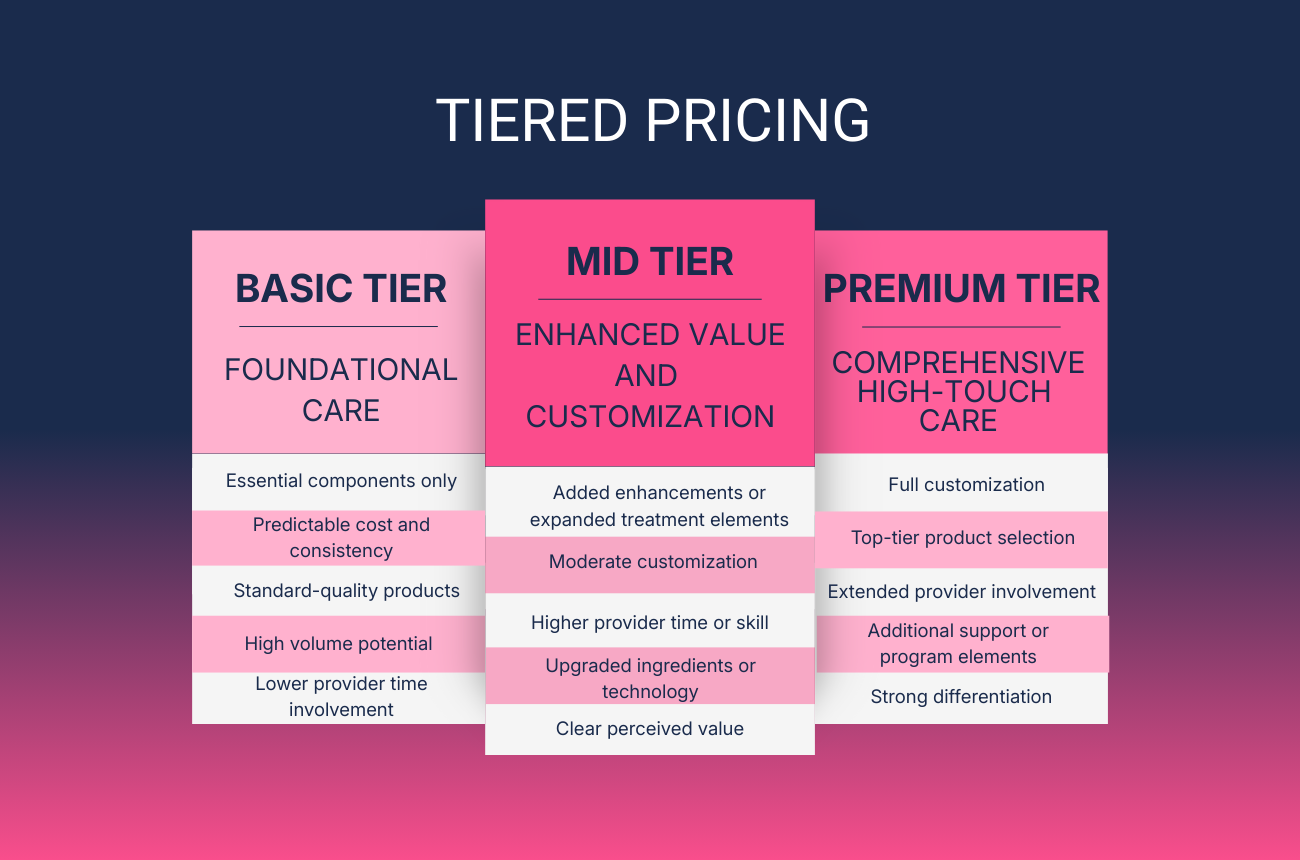
When designing your tiered pricing structure, each level should be built around clear, strategic differences in value, complexity, and resource use. Instead of thinking in terms of specific treatments, consider the following criteria for each tier:
Basic Tier: Foundational Care
The basic tier serves as the entry point for patients seeking an accessible option. It should focus on:
- Essential components only—the minimum effective elements required to achieve a standard clinical outcome.
- Lower provider time involvement, typically requiring straightforward workflows and minimal customization.
- Standard-quality products or ingredients, without premium upgrades.
- Predictable cost and consistency, helping new or budget-conscious patients feel comfortable.
- High volume potential, offering strong profitability through efficiency and repeatability.
Mid Tier: Enhanced Value and Customization
The mid-tier should appeal to patients wanting elevated results without committing to a premium price point. This tier typically includes:
- Added enhancements or expanded treatment elements that meaningfully improve results.
- Moderate customization, such as adjusting components based on patient goals or clinical indications.
- Higher provider time or skill, justifying the price difference while still maintaining operational efficiency.
- Upgraded ingredients or technology, but not the full suite reserved for premium care.
- Clear perceived value, making this tier feel like the “smart choice” for most patients.
Premium Tier: Comprehensive, High-Touch Care
The premium tier should represent the highest level of service, emphasizing exclusivity and complete care. It should include:
- Full customization, tailored protocols, or additional services that maximize outcomes.
- Top-tier product selection, premium formulations, advanced devices, or high-demand enhancements.
- Extended provider involvement, such as deeper clinical assessments, follow-up, or specialized monitoring.
- Additional support or program elements, which may include guidance, tracking, or concierge-style communication.
- Strong differentiation, making the tier feel like a comprehensive, all-inclusive experience rather than a small upgrade.
Step 3: Set Pricing Strategically
Pricing should reflect your costs, market, and desired profit margin:
- Competitive research: Understand what similar practices charge in your area.
- Margin goals: Each tier should cover costs and generate a sustainable profit.
- Patient psychology: Round numbers (e.g., $199 vs. $200) and perceived value can influence decisions.
- Upsell incentives: The mid-tier should feel like a clear upgrade from the basic option, while the premium tier should feel exclusive and worth the investment.
Step 4: Integrate Tiered Pricing Into Your Practice Management
To make tiered pricing seamless:
- EMR & Scheduling: Ensure your system can track different tiers and allow staff to select the correct service during scheduling.
- Point-of-Sale & Billing: Automatically generate accurate invoices based on tier selection.
- Staff Training: Educate staff on explaining tiers clearly to patients, highlighting the value of upgrades.
With the right system, tiered pricing becomes a simple, repeatable workflow that boosts revenue without increasing friction.
Step 5: Monitor, Adjust, and Promote
Once implemented, monitor your tiered pricing strategy:
- Track which tiers are most popular and which have higher patient satisfaction.
- Adjust tiers and pricing periodically based on product costs, staff time, and patient feedback.
- Promote higher tiers via your website, social media, and email campaigns to increase uptake.
The flexibility of tiered pricing allows your practice to adapt to patient demand and market trends over time.
Examples of Tiers For IV Therapy, Hormone Therapy & Aesthetics
- IV Therapy:
- Basic: Core hydration and essential vitamins
- Mid: Add targeted vitamins and antioxidants
- Premium: Add high-demand boosters like glutathione or immune support
- Hormone Therapy:
- Basic: Routine hormone balancing
- Mid: Customized protocols with lab monitoring
- Premium: Comprehensive program with concierge support and follow-up
- Aesthetic Add-Ons:
- Basic: Single service enhancement (e.g., lip filler)
- Mid: Combination treatments or higher-quality products
- Premium: Full treatment package with follow-up care
Clearly defining tiers ensures patients understand their options and reduces confusion at the front desk.
Unlocking Profit and Patient Happiness
Tiered pricing for IV therapy, hormones, and aesthetic add-ons is more than a revenue strategy—it’s a tool to offer patients choice, transparency, and value. By carefully analyzing costs, defining clear tiers, setting strategic prices, integrating with your practice systems, and monitoring results, your clinic can increase profitability and patient satisfaction simultaneously.
With an advanced practice management and EMR platform like OptiMantra, you can easily implement tiered pricing, track patient selections, and ensure smooth billing—all while delivering a seamless, professional patient experience.
Try a personalized demo or start a free trial of OptiMantra today and see how our platform streamlines tiered pricing to support your practice’s growth.